
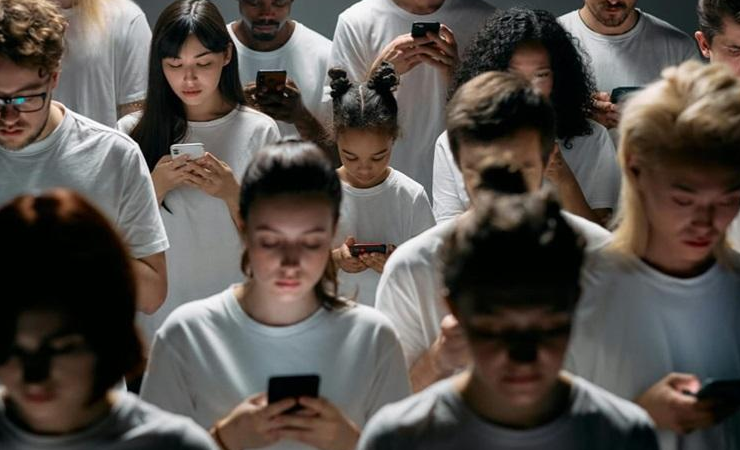
In a world where doomscrolling is commonplace and TikTok dominates discourse, it's easy to conclude that culture has turned into a shallow puddle. Warnings of a "cultural dark age" flood our feeds: a recent YouGov poll found Americans rated the 2020s "the worst decade in a century" for music, movies, and more. Pundits decry "transcendent art" as relics of the past. Yet curiously, we've never had more content available: streaming services add 100,000 songs every day, and over 500 scripted TV shows debut each year.
The paradox is striking: we live in a creative Cambrian explosion, but many fear it's all noise, not nuance.
This isn't just hand-wringing. The digital attention economy has indeed colonized our minds. Tech titans openly admit it. Eric Schmidt, ex-CEO of Google, warns that modern apps and ads constantly "monetize your attention," making deep focus impossible. Psychologists have measured the result: the average user now holds attention for only ~47 seconds at a time on a screen, down from 2.5 minutes two decades ago. In other words, our digital companions have literally trained us to flit from one stimulus to the next. The symptoms of an attention recession are everywhere: productivity gurus endlessly lament "brain rot," and social commentators warn of a generation weaned on dopamine hits.
Yet before we conclude that culture is irretrievably shallow, a deeper look reveals nuance. Yes, short-form content is omnipresent – TikTok videos, Instagram Reels and Stories, 15-second meme-ads, and our reflex is to blame these formats for an alleged collapse of patience. But actual consumption patterns are more complex.
Studies show that attention spans are diversifying rather than simply shrinking. Young people do binge quick hits, but many equally devour long-form media. As Reuters Institute researcher Gretel Kahn reports, Gen Z audiences on YouTube and Twitch routinely spend hours at a time on single videos or livestreams. Podcasts like Joe Rogan's three-hour episodes routinely draw millions of younger listeners. YouTube's own data suggests nearly half of trending videos now resemble full-length TV: interviews, game shows and mini-documentaries that clock in at 10–40+ minutes. In short, children of the internet haven't lost the ability to focus. They've simply distributed it differently, often gravitating to content that feels authentic or interactive.
Even platforms built on virality are pivoting. Digiday reports the number of YouTube videos longer than 20 minutes shot up six-fold between July 2022 and June 2024. What was once considered countercultural (long videos on social media) is now mainstream. Millennial and Gen Z viewers aren't watching less video; they're watching different kinds of video. This return of "long form" isn't confined to news. Netflix features mini-episodes and bite-sized docs, but it also greenlights multi-hour films and spinout podcasts. In fact, many creators use short clips as trailers, then funnel fans to deeper content – the social media equivalent of a highbrow magazine's cover story teasing a full investigation.
The Real "Cultural Cost"
That said, there is a genuine cultural shift underway, and it comes with trade-offs. The Guardian recently reported U.S. leisure reading rates have fallen 40% over two decades. Only 16% of Americans now read daily for pleasure (down from 28% in 2004). This decline isn't entirely new. Smartphones, streaming and Instagram have given adults and teens countless alternatives to settling in with a novel or long article. Even libraries are seeing fewer patrons, and many young writers admit they skim Wikipedia or watch video essays instead of wading through encyclopedias.
Meanwhile, critics of today's pop culture point to symptoms: diminishing album sales despite ever-more music, blockbuster movies retold endlessly in formulas, and viral "expert" hot-takes replacing in-depth analysis. Highbrow commentators grieve that you can't expect people to savor a 10,000-word New Yorker essay when they're used to 280-character threads. Education systems worry that classroom attention spans have collapsed.
These concerns aren't baseless. Deeper engagement and sustained immersion in a piece of art or scholarship does seem rarer in daily life.
A college professor told The Atlantic that many of her students feel shearing their focus: "I almost can't bear to listen to full albums; sometimes I'll just play a song for 30 seconds to feel that texture," one young critic confessed. New streaming shows often demand binge-watching, but ironically, bingeing itself can become background noise: pressing "next episode" on autopilot feels very different from savoring an hour of cinema. In the art world, micro-trends and TikTok-driven hype cycles can push nuance aside for the one-line slogan or headline-grabbing stunt.
The analysis even likened today's culture to a "messy hybrid" where images and ideas fly faster than we can process. In a sense, the mechanics of consumption have sped up. We now swipe through museum collections on apps, see only the highlights of an opera on YouTube, and get the TED Talk soundbites instead of the full academic lecture. The danger is that, without effort, culture could slip from background acclaim to background noise – lots of quantity, but not much meaning.
When "moments" displace movements, and memes displace manifestos, something is lost.
Amid Panic, a Silver Lining
Yet while the medium of culture is changing, the human hunger for meaning has not vanished. Indeed, the recent cultural moment shows surprising resilience and adaptation. Critics of the "brain rot" generation often overlook how creators themselves are reinventing depth for the new age.
As The Atlantic observed, today's artists are forging a new maximalism to meet our maximal stimuli. Barbie and Oppenheimer – two wildly different films – both succeeded in 2023 by acknowledging our brief attention spans: Barbie's kaleidoscopic, hyper-energetic style kept audiences rapt while still delivering weighty themes, and Nolan's Oppenheimer leapt forward in TikTok-sized narrative vignettes even as it tackled nuclear ethics. In other words, what might have been 2 hours of slow burns became a sprint of vignettes that feels modern, yet still contains depth.
In music, experimental stars like PinkPantheress produce minute-long songs that nonetheless resonate profoundly. Writers such as Honor Levy ("And We Got Away" on Tumblr) are weaving "lurid short stories out of internet slang," showing that even fragmented digital languages can hold surprising lyricism. These creators prove that you can encode depth in a distilled form. In fact, some of today's most moving art is explicitly aware of the speed of life. The Alternative Press scene, TikTok poets, and meme artists all find philosophical or emotional depth within brevity. As novelist Roxane Gay notes, the job now is to meet audiences on their terms – to embrace brevity where it works, and then reward lingering interest with layers to uncover.
There's also evidence from media markets: ironically, the most attention-driven projects are failing to captivate. The Nieman Journalism Lab noted that 2025's hit stories were often the weird, authentic ones, not the polished ad-campaign projects. Celebrities who gambled everything on viral marketing (the "Attention Economy") found hollow returns; one editor quipped that chasing clicks is now "unpredictable, fleeting, high risk/low reward". In contrast, quality investigative pieces, immersive narratives, and thoughtful podcast series continue to break through and build loyal audiences. This suggests that good work still matters – even if it doesn't flash as brightly on the X (formerly Twitter) feed.
Where Culture Goes From Here: Depth Meets Speed
So what should cultural institutions and creators do? The answer is not to turn back the clock, the genie of instant access and endless content is out of the bottle. Instead, we need a hybrid strategy: blending short and deep, speed and substance.
First, we must redefine "quality." Audiences today often judge a work by how it makes them feel, rather than its production glitz. In Deloitte's 2026 Media Outlook, experts note that platforms (from TikTok to Netflix) are shifting our sense of value: nowadays content quality often means relevance and experience, not just high budgets. A user on a smartphone might be equally satisfied by a grainy indie film trailer that speaks to them, as by a big-budget epic. Cultural institutions could lean into this: a film museum, for instance, might complement lectures with VR experiences or interactive exhibits that engage short-term visitors while spotlighting deeper content for those who want it.
Second, embrace "micro vs. macro" distribution. Short-form content can serve as an innovation lab or appetizer. Deloitte suggests that mini-dramas and micro-content can safely test ideas and build buzz before larger investments. The Met's TikTok behind-the-scenes clips, for example, don't replace seeing a painting but can entice younger viewers to a museum. Podcast snippets or YouTube shorts can highlight one key insight from a lecture series, then link to the full talk. In publishing, article threads or illustrated summaries can whet readers' appetites for the full essay. This funnel strategy doesn't dumb down the material – it simply meets people where they are before guiding them deeper.
Third, cultivate attention as a skill. Just as we teach digital literacy, schools and workplaces can encourage periods of focused attention. (Even Silicon Valley's own advisers, from Eric Schmidt to Cal Newport, now tout "digital Sabbaths" or mindfulness to regain focus.) Libraries and cultural foundations could run campaigns teaching "slow media": digital detox events, community readings, curated playlists that gradually increase in length or complexity. Corporate and academic cultures that value uninterrupted concentration, building "think time" into schedules, will support more thoughtful creation.
Finally, acknowledge that cultural depth will never have a single format. Our hyper-fragmented era means plurality: a deep narrative today might be a blockbuster film, tomorrow a bestselling novel, and the next day a serialized graphic webcomic or even a game. We should celebrate and incubate all of these. Indeed, audiences may be losing time, but they're gaining choice. We need not mourn a loss of attention, perhaps it's just being reallocated. The "most telling moments of 2025," notes one media analyst, showed success coming to creators who did not chase hype but focused on craft.
In the end, culture need not be a zero-sum game of "depth vs. speed." The Better Voice platform, after all, is built on the idea that everything can be improved. If we define the problem as a simple loss of attention, we risk peddling despair. Instead, let's envision new models. Imagine a world where short TikTok clips hook you on a topic, then voilà – a VR experience or longform video follows seamlessly. Newsrooms will be funding both five-minute explainer TikToks and three-hour investigative podcasts. Classrooms shall be using AI to generate quick quizzes to spark curiosity, then assigning the actual classics for weekend reading.
We are at a cultural inflection point: one foot in the sprint of the attention economy, one in the marathon of human creativity.
The question shouldn't be whether depth is dead, but how depth can evolve. By being intentional about our media diet, curating both a few slow-burn "gourmet" pieces and the bite-sized snacks, we ensure that cultural depth isn't erased, just reformatted. After all, innovation often thrives under constraints. If our attention is harder-won, the payoff of profound art could be all the greater.
The challenge for creators and consumers alike is to remember that a 15-second video is merely the trailer; the full feature still awaits those willing to press play.
Sources: A wealth of recent reporting underpins these observations. For example, media analysts note a resurgence of long-form content despite short-form hype. Psychologists report our screen-based focus has shrunk dramatically, and cultural studies show U.S. reading for pleasure has plunged ~40% in 20 years. Thought leaders caution against blindly chasing clicks, noting that work of "lasting quality" still finds audiences. Industry reports (Deloitte, Pew, Ofcom, etc.) likewise emphasize that value today is measured in relevance and engagement, not just production gloss. As always, the full picture is complex – but one thing is clear: culture is far from dead. It's simply changing shape. (All references are drawn from reputable outlets such as The Atlantic, The Guardian, Deloitte Insights, Business Insider, Nieman Lab, and Fast Company.)