
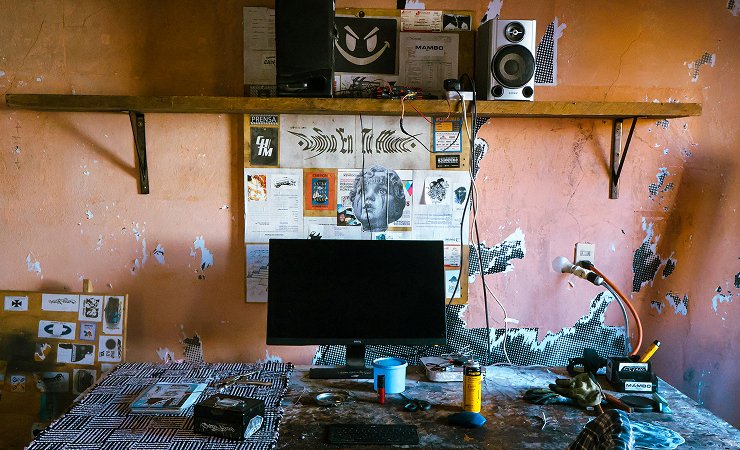
For years, digital culture moved toward perfection.
Photos became cleaner. Branding became flatter. Interiors became minimal. Faces became filtered. Social media feeds evolved into highly controlled aesthetic systems where every detail appeared optimized for visibility, consistency, and algorithmic approval. Then artificial intelligence arrived and accelerated everything even further.
Today, AI can generate logos, campaigns, illustrations, music, videos, copywriting, photography, and entire visual identities within seconds. Creativity, once associated with process and experimentation, increasingly risks becoming instant, frictionless, and infinitely reproducible.
And yet, something unexpected is happening across culture.
People are beginning to push back.
In fashion, branding, interiors, photography, publishing, and design, a visible shift is emerging away from sterile digital perfection and toward texture, irregularity, tactility, and visible human presence. What once looked polished now often feels emotionally empty. What once appeared futuristic increasingly feels algorithmic.
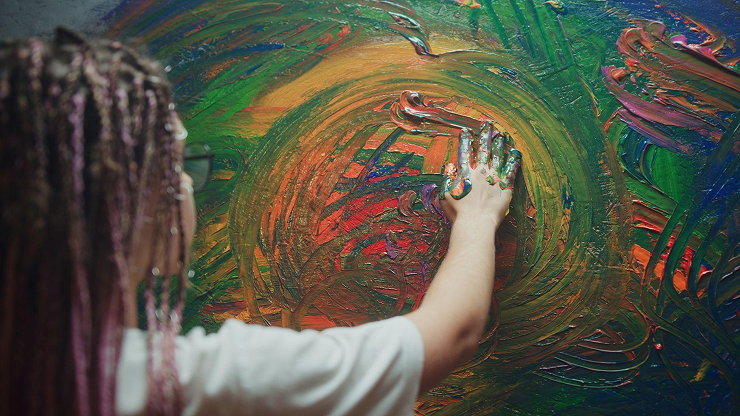
And in response, culture is rediscovering the value of the human hand.
This is not simply nostalgia. It is becoming one of the defining aesthetic and psychological reactions of the AI era.
The trend is already visible across major global creative industries. Canva's 2026 design trend report identified "Imperfect by Design" as one of the year's defining visual movements, noting a growing preference for handmade textures, visible imperfections, raw typography, collage aesthetics, tactile materials, and emotionally expressive visuals over hyper-polished digital minimalism.
The shift reflects something deeper than aesthetics alone. It signals growing fatigue with environments that feel excessively optimized.
For more than a decade, digital culture rewarded smoothness. Instagram encouraged carefully curated lifestyles. Brand identities became simplified into universally recognizable minimalist systems. Coffee shops across cities began resembling one another. Airbnb interiors converged into neutral palettes and algorithm-friendly sameness. Even personal identity increasingly became aesthetic performance.
Artificial intelligence intensified this homogenization dramatically. Generative AI systems are trained on vast datasets of existing visual culture, meaning they often reproduce the average logic of what already performs well. The result is technically impressive—but culturally repetitive.
This is precisely why terms like "AI slop" have entered mainstream creative conversation. Publications such as Vogue and creative industry platforms increasingly discuss the growing backlash against mass-produced AI-generated visuals flooding social media and digital spaces. The criticism is not merely about quality. It is about emotional absence.
People are beginning to sense when something lacks friction.
Human creativity has historically been shaped by imperfection: brushstrokes, accidental distortions, uneven textures, flawed performances, spontaneous ideas, personal memories, regional influences, physical materials, and emotional unpredictability. AI can imitate style remarkably well, but it often struggles to reproduce the emotional residue of lived experience. And audiences increasingly notice the difference.
This explains why handmade aesthetics are resurging so powerfully. Across fashion, artisanal craftsmanship, visible tailoring, hand embroidery, textured fabrics, and analog techniques are regaining cultural relevance. Luxury itself is slowly shifting away from excessive polish toward evidence of process and individuality. What once looked "unfinished" now often feels more authentic than highly perfected digital surfaces.
The same movement is visible in graphic design and branding. Designers are reintroducing grain, asymmetry, layered textures, handwritten typography, collage techniques, and deliberately imperfect layouts into campaigns and visual identities. Creative Bloq's recent design trend analysis noted that many artists and designers are intentionally embracing tactile, analog-inspired aesthetics as a response to growing AI saturation.
This is not anti-technology romanticism. Most creatives are not rejecting AI entirely. Many actively use it as a tool. The shift is more nuanced than that. What culture increasingly rejects is not technology itself, but emotional uniformity.
People want evidence of humanity again.
The psychological reasons behind this shift are important. Human beings are emotionally responsive to imperfection because imperfection signals presence. A slightly uneven ceramic object, a visible paint texture, a handwritten note, a film photograph, or a voice with irregularity often feels more intimate precisely because it contains traces of human limitation. Perfection can impress. Imperfection connects.
In many ways, this explains why younger generations are increasingly drawn toward analog experiences despite growing up inside digital ecosystems. Vinyl records, film cameras, independent bookstores, handcrafted objects, live performances, textured interiors, artisan cafés, vintage fashion, and slow creative processes are all benefiting from this broader emotional movement.
The future may be technologically accelerated, but emotionally, people are craving grounding. Fashion exhibitions and museums are also responding to this tension. Recent exhibitions emphasizing physicality, embodiment, and material craftsmanship increasingly position fashion not merely as commerce or trend, but as emotional and artistic expression in response to AI anxiety and digital abstraction. The growing fascination with couture craftsmanship reflects a desire to reconnect with visible labor and physical artistry in a world dominated by digital reproduction.
This shift has enormous implications beyond art alone.
It affects branding, marketing, architecture, luxury, retail, publishing, and even corporate communication. Companies are beginning to realize that overly polished AI-generated branding risks becoming indistinguishable from everyone else's. As AI democratizes production, originality may increasingly come not from perfection, but from personality. Ironically, the more artificial content floods digital spaces, the more valuable human distinctiveness becomes.
This may fundamentally reshape the future of creativity itself. For years, technology pushed culture toward optimization: cleaner interfaces, smoother visuals, faster production, greater efficiency. But optimization often strips away unpredictability—the very quality that makes art emotionally memorable.
Culture appears to be correcting for that imbalance.
The rise of textured aesthetics, slow craftsmanship, visible process, and emotional imperfection suggests that people are searching for work that feels lived rather than generated. In a world where AI can imitate almost anything, the rarest quality may no longer be technical precision. It may be emotional authenticity.
And perhaps that is why the "human hand" suddenly matters so much again.
Not because humans can outperform machines technically, but because human imperfection contains something machines still struggle to replicate fully: emotional context, memory, vulnerability, and presence.
The future of creativity may therefore not belong entirely to AI-generated perfection or to anti-technology resistance. It may belong to hybrid forms where technology enhances creation without erasing human texture.
Because ultimately, culture is not driven only by efficiency.
It is driven by feeling.
The Better Voice Perspective
At The Better Voice, we believe the growing rejection of AI perfection reflects a deeper cultural realization: humanity does not merely consume aesthetics—it searches for emotional resonance.
Artificial intelligence can replicate styles, automate production, and optimize visual systems at extraordinary speed. But culture has always been shaped by more than technical output. It is shaped by memory, imperfection, contradiction, experimentation, and lived experience.
As AI-generated content becomes increasingly abundant, human-made irregularity may become one of the most valuable forms of creative differentiation.
The future of culture may therefore not be defined by perfection.
But by the visible return of humanity inside systems increasingly designed to automate it.
And in a world flooded with generated content, the most powerful creative signature may simply become evidence that a human being was truly there.