
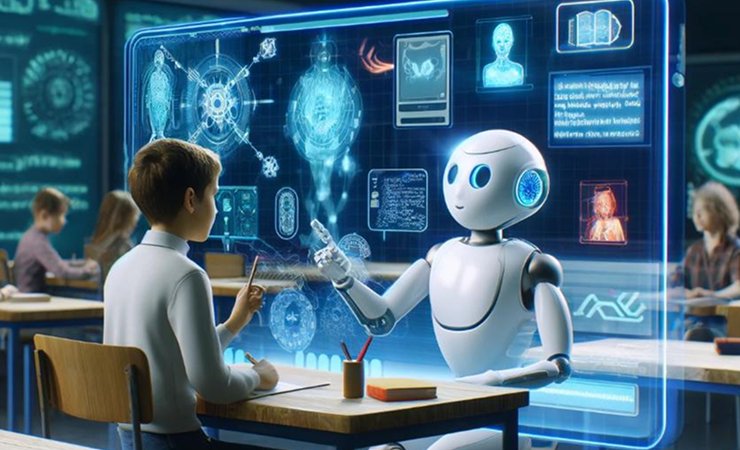
In 2026, the central question is no longer whether artificial intelligence belongs in education. It already does. The real question is whether schools will use it to deepen human thinking or to automate it away.
The most influential teacher in 2026 may not stand at the front of a classroom at all. It lives inside a tab, a chatbot, a study tool, a homework assistant.
That is not because algorithms have suddenly become wiser than human educators. It is because they have become more available than the system students are trying to learn through.
RAND reports that AI use by students and teachers has risen by roughly 15 percentage points or more in just one to two years, even as training and policy lag. OECD has meanwhile found that AI use is already concentrated in homework support and that, in one 2025 survey of 3,564 primary and secondary teachers, 66% reported using AI at school.
That is why the usual debate — should AI enter education? — already feels dated. Bloomberg Businessweek has reported on chatbots moving directly into lesson plans in American classrooms. OpenAI has launched a study mode built around step-by-step guidance rather than instant answers, while Google has rolled out more than 30 classroom AI features, from lesson planning to interactive study guides. Even Khan Academy frames its AI tutor as something that should guide learners, not simply hand them the answer, and TechCrunch has chronicled the broader push to train teachers for precisely that shift.

When a leading teachers’ union starts building an AI academy with industry backing, this stops being a novelty story and becomes a systems story. American Federation of Teachers is launching a five-year national academy for AI instruction, and TIME reported that the effort comes with $23 million in backing to help educators use AI for lesson plans, quizzes and family communication. OpenAI says the broader initiative aims to equip 400,000 K-12 educators to shape how AI is used in schools.
The signal is unmistakable: education is not merely adopting AI tools; it is reorganising around them.
This is happening because the labour market has changed faster than the curriculum. World Economic Forum says 39% of key skills in the job market are expected to change by 2030, with AI and big data among the fastest-growing capabilities, alongside creativity, resilience and lifelong learning. In other words, AI is not simply giving schools a new tool. It is exposing that the old bargain of education — memorise first, apply later — no longer fits the world students are entering. But AI is filling a genuine vacuum, not just creating hype. One 2025 trial found that students using a carefully designed AI tutor learned more in less time than peers in an in-class active-learning condition and also reported higher engagement and motivation.
AI is not winning because it has solved pedagogy. It is winning because it scales attention in systems that chronically undersupply it. That is also why the smartest use cases are surprisingly unglamorous. The most immediate gains are not in replacing the teacher’s judgement but in reducing the administrative drag that keeps teachers from exercising it. TIME’s 2025 edtech ranking noted that many platforms are using AI to make teachers’ jobs easier, from analysing student work to helping feedback happen at scale. Many educators now treat AI less as a passing threat than as a permanent part of the profession that must be guided responsibly.
And yet convenience has a habit of becoming authority. RAND reports that students and parents already worry that more AI use could weaken critical thinking, and a 2026 youth survey from the same organisation explicitly recommends helping students use AI to enhance learning rather than replace it. A recent peer-reviewed study went further, concluding that generative AI without guardrails can harm learning outcomes in high-school mathematics. The warning here is not anti-technology. It is anti-outsourcing. A student who can produce fluent work is not necessarily a student who can think fluently. The risk is not only cognitive. It is civic and ethical. UNESCO now argues for a human-centred, rights-based approach to educational AI, warning that technology should strengthen learning opportunities rather than endanger the right to education.
That caution matters because the most valuable parts of schooling were never merely informational. They were social: accountability, disagreement, resilience, and the ability to stay with a difficult idea long after the first answer arrives. Even strong advocates of classroom AI keep returning to that point; the human adult in the room still carries the social and moral weight of teaching.
So what should education look like?
A system that uses AI chiefly to cut staffing costs will produce brittle learning. A system that uses it to expand human attention might finally become more intelligent itself.
The better shift, then, is not from teachers to machines. It is from industrial-era schooling to human-led, AI-supported learning. Algorithms can explain, translate, rehearse, simulate and personalise at astonishing scale. They can reduce workload and widen access to tutoring. But they cannot decide what is worth knowing, what counts as good judgement, or what kind of citizens schools ought to form. That remains a human responsibility. In 2026, AI is quietly becoming the world’s most influential teacher. The task for education is to make sure it never becomes the one that matters most.