
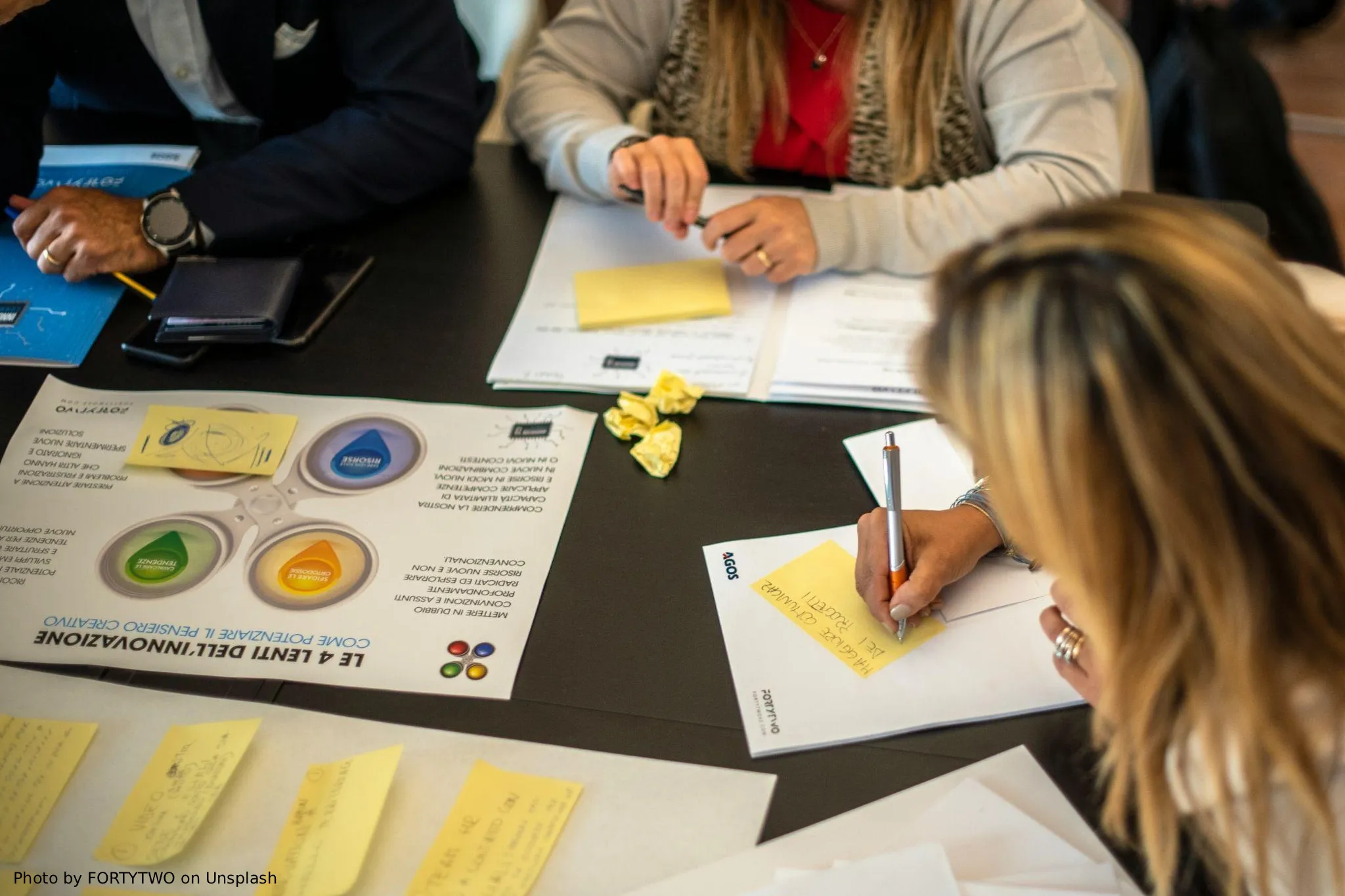
Adult experts are not creative enough to solve all the global problems threatening the future of our planet.
The trajectories created by adult thinking have led us to where we are today: the damaging environmental effects of climate change, employment upheaval, and an existential crisis created by artificial intelligence. These experts have not yet been creative enough to significantly alter those trajectories.
Adult experts are often past their creative prime and can become “over-knowledged” about the details of failed attempts to solve the biggest problems in their fields. This overfamiliarity can greatly reduce creativity by creating fixation on existing ideas, approaches, and limitations. This is sometimes referred to as design fixation.
Teenagers do not face the same limitations. They are at one of the highest peaks of originality in their lives, second only to the period between the ages of three and six.
A Global Problems Pilot Study
During the 2025–26 academic year, a pilot study gave teenagers from Eagle Hill School in Hardwick, Massachusetts, six global problems to consider.
According to domain experts who reviewed their work, the teenagers developed solutions to four of the six problems.
An aerospace engineer described their design for removing orbital space debris as “a fantastic concept.” In response to their flood-proof home design, a civil engineer said, “OMG. I love it.”
Research suggests that teenagers’ ideas can be more original than those of adults, although they may sometimes be less plausible or practical (Stevenson et al., 2014).
This suggests a new innovation model: teenagers lead the early creative work, while adult experts refine, test, and implement the most promising ideas.
The Next Step: Entrepreneurship
Solving global problems may turn out to be the easier part of the innovation process.
It takes considerable effort to persuade companies to take teenagers’ designs seriously, even when the teenagers simply want the problems solved and are willing to give their designs away for free.
Capitalism can get in the way of solving some global problems. As a result, the teenagers had to become creative not only in designing solutions, but also in explaining how those solutions might generate revenue.
Orbital space debris is an urgent and worsening problem, but the teenagers still had to address the commercial question. They showed that their design could also be used to capture small- to medium-sized asteroids for mining purposes, creating a potentially profitable application.
They also had to rethink how to present their flood-proof home design. Instead of pitching it only to construction companies, they considered approaching home insurance companies. Insurers could potentially encourage or require the use of flood-resistant designs in high-risk regions.
In this way, the teenagers began learning that innovation is not only about solving a problem. It is also about understanding who benefits, who pays, and how an idea can move from concept to implementation.
When Knowledge Is Too Much or Too Little
The two problems the teenagers did not solve revealed an important limitation.
In those cases, they did not possess the minimum level of foundational knowledge required to approach the problem effectively. One challenge involved developing new methods of carbon capture, but the teenagers in the group did not have sufficient knowledge of chemistry to build a workable foundation.
Adult experts can become “over-knowledged,” but teenagers can certainly be under-knowledged.
The amount of knowledge needed for creativity may have to be “just right.”
Ongoing research is attempting to characterise this “Goldilocks knowledge zone”: the level of understanding that supports innovation without creating so much familiarity that creativity begins to decline.
Having Knowledge That Is “Just Right”
The teenagers were most successful with engineering problems.
Living in a human body for a decade or two may give them enough embodied knowledge to understand basic physical and engineering principles. For the orbital space debris problem, they needed to learn several things about how objects behave in space, but the amount of additional knowledge required was manageable.
Teenagers periodically appear in the news because of major inventions and discoveries.
Boyan Slat developed a mechanism for removing plastic from the ocean. Perhaps even more impressive than the invention itself is the ambition of his goal: to remove 90% of floating ocean plastic by 2040.
Mia Heller developed a novel method for removing microplastics from water. Ne’Kiya Jackson and Calcea Johnson created multiple new approaches to proving the Pythagorean Theorem.
The list continues.
Although teenage innovation regularly attracts attention, the broader creative potential of teenagers remains largely untapped.
What AI Can and Cannot Contribute
Could AI amplify teenagers’ innovative abilities?
For the most creative part of the process, the answer is largely no. However, there are a few areas where AI may still be useful.
Teenagers are often more creative than AI. David Cropley (2025) mathematically argued that no large language model can exceed the creativity of an average human.
In 2017, I published the first mathematical proof proposing that there is a severe limit to how creative any machine can be. AI systems beyond large language models may also be subject to this limitation.
The deeper issue is that human creativity does not always begin in language.
Human Intuition Is Often Pre-Verbal
Jacques Hadamard compiled accounts of how leading mathematicians and physicists experienced thought and invention.
Einstein described his thinking as beginning not with conventional words, but with signs, images, and bodily or “muscular” sensations. Words came later, after the initial pattern of thought had already formed.
Consider Einstein’s thought experiment involving a person inside a closed, falling elevator. The imagined experience was partly visual and partly bodily.
Through this thought experiment, he recognised that acceleration and the effects of gravity could appear indistinguishable from the perspective of someone inside the elevator. Only after this visual and bodily insight did the difficult work begin of expressing the idea through language and mathematics.
Human beings can access pre-verbal forms of intuition through imagery, sensation, movement, and lived experience. It can then take significant effort to translate those insights into words or symbols that AI can work with.
One Simple Creativity Technique
The following technique can help even teenagers, who often need less assistance than adults in generating original ideas.
The first step is to describe an object or idea generically. Doing this strips away layers of common associations that can keep the mind trapped within familiar uses. Consider the RMS Titanic, which did not carry enough lifeboats for everyone on board. Historical accounts describe the crew as focusing on placing passengers into lifeboats, with no clear alternative once those boats ran out.
If a lifeboat is described generically, it becomes “something that floats.” That broader description encourages the mind to notice other floating resources: large dining tables, doors, planks, steamer trunks, or other materials that could potentially help keep people above water. Perhaps makeshift floating surfaces could have been constructed. Perhaps additional options could have been explored once the word “lifeboat” no longer defined the entire solution space.
The technique works because it helps people uncover useful but overlooked features of a problem. It is only one of several creativity methods designed to reveal possibilities that familiar labels and assumptions hide.
A New Model for Innovation
Teenagers may be the largest untapped source of creativity in the world. They are also among the biggest stakeholders in the future because they will inherit the planet, its systems, and the consequences of the decisions adults are making today. Fortunately, they possess both the creative ability and the personal motivation to participate in solving difficult problems.
The most effective model may not require choosing between teenage originality and adult expertise. Teenagers can generate bold, unconventional ideas. Adult experts can contribute technical knowledge, testing, refinement, and implementation. Entrepreneurs, companies, and institutions can help transform promising concepts into workable solutions.
Companies, schools, universities, and research organisations should actively seek out groups of teenagers to help address the world’s most difficult problems.
The future belongs to them. They should be invited to help design it.
About the Author
Dr. Tony McCaffrey holds a PhD in cognitive psychology, specializing in creativity and problem solving. He has co-authored academic papers, published in Harvard Business Review and guides teen students to use their imagination to solve global problems.
References
Cropley, D. H. (2025). “The Cat Sat on the …?” Why generative AI has limited creativity. The Journal of Creative Behavior, 59(4), e70077.
https://doi.org/10.1002/jocb.70077
Hadamard, J. (1996). The Mathematician’s Mind: The Psychology of Invention in the Mathematical Field. Princeton University Press. Original work published 1945. McCaffrey, T., & Spector, L. (2017). An approach to human–machine collaboration in innovation. Artificial Intelligence for Engineering Design, Analysis and Manufacturing, 1–15.
https://doi.org/10.1017/S0890060416000524
Stevenson, C. E., Kleibeuker, S. W., de Dreu, C. K. W., & Crone, E. A. (2014). Training creative cognition: Adolescence as a flexible period for improving creativity. Frontiers in Human Neuroscience, 8, Article 827.